
Something has shifted in the way Texas families choose where to live. For decades, the gravitational pull of Austin meant that most professional families landed in the city’s suburbs — close to work, close to amenities, hemmed in by subdivision walls and HOA rules. Over the last decade, that calculus has changed. Moving to Dripping Springs and the Texas Hill Country has gone from a lifestyle choice for a handful of people to a full-scale migration, and the families making the move are not looking back. Here is why.
The Land: Why This Place Gets Under Your Skin
There is something that happens when you stand on a Hill Country property for the first time and look out over limestone bluffs, live oaks, and a sky that goes on longer than it should. It does not feel like suburban Texas. It feels like a different country entirely.
Scenic Beauty That Is Actually Livable
People come to the Hill Country for the views — the rolling cedar-covered hills, the creek beds that run clear after a rain, the wildflowers in spring that cover the highway medians and spill into every pasture. What keeps them here is that the beauty is not just for looking at. You can swim in it, ride through it, build a home in the middle of it, and sit on your front porch every morning with coffee watching it change with the light.
Space and Real Privacy
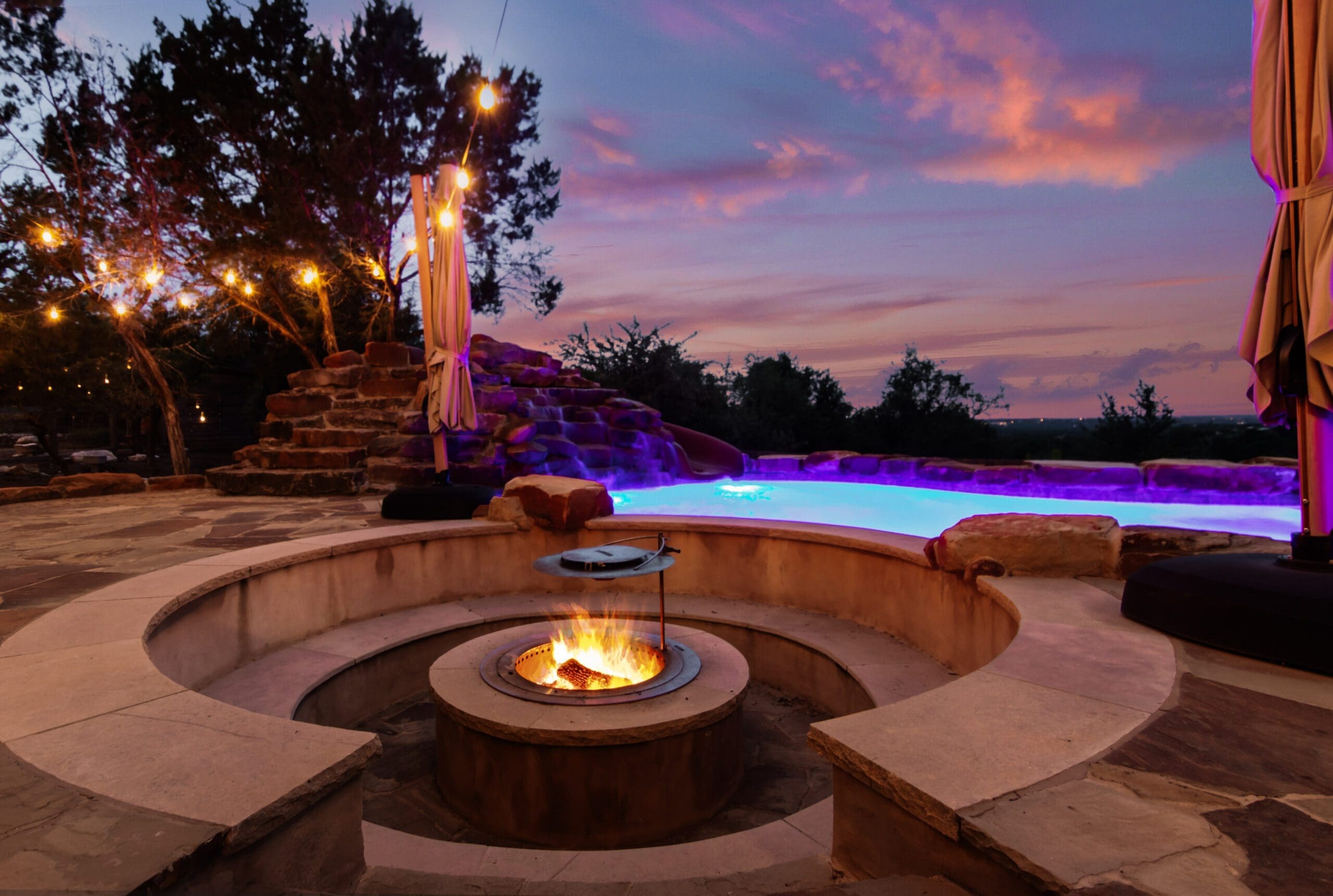
This is not a subtle point. On an acreage property in Dripping Springs or Wimberley, you can build a home with a pool, a covered outdoor kitchen, a barn for your horses or equipment, and a casita for guests — and still have pasture between you and your nearest neighbor. Your kids can ride bikes on a long driveway without worrying about traffic. You can have a bonfire without a neighbor calling the city. Dogs can run. Privacy here is not a premium upgrade — it is just how properties are structured.
If you are curious about what a property like this looks like with a barn, pool, or casita, we have built all of them and can walk you through the options.
Nature as a Daily Reality
Deer in the yard before breakfast. Wildflowers in March. Creek crossings after rain. Fireflies in June. The Hill Country is not a nature destination you visit on weekends — it is the backdrop of daily life. Families with children consistently cite this as one of the biggest reasons they made the move and one of the most meaningful parts of raising kids here.
Community: Small-Town Feel With Big-City Access
One of the most common things we hear from families who have moved to Dripping Springs or the surrounding Hill Country communities is this: “I did not realize how much I missed living somewhere where people actually know each other.” The community culture here is genuinely different from a suburb.
Dripping Springs: 25 Minutes from Austin
Dripping Springs sits at the edge of the Hill Country, just off US-290 West, about 25 minutes from the heart of Austin and less than that from the tech corridors of Southwest Austin. Families who commute to Austin two or three days a week — or not at all, with remote work — find the distance trivially manageable. You get the restaurants, the music, the airport, and the major medical centers of Austin within reach while living somewhere that feels nothing like it.
Towns like Wimberley and Driftwood are a bit further out and offer an even more rural character — ideal for families who want maximum land and minimum urban proximity.
Schools That Families Move Here For
Dripping Springs ISD consistently earns high ratings from state accountability systems and parent organizations. The school district is small enough that your child is known as an individual, not a number — but large enough to offer strong academics, arts, and athletics programs. Families routinely cite DSISD as a primary reason for choosing Dripping Springs over comparable properties closer to Austin. The community wraps tightly around its schools — Friday night football, FFA competitions, and community theater productions are real events that pull the town together.
Local Culture: Wineries, Breweries, Farmers Markets, and Music
The Hill Country has developed its own food and culture scene that does not require a drive to Austin. The Fitzhugh Road corridor between Dripping Springs and Bee Cave has become one of the most concentrated collections of craft breweries in Texas. The area’s wineries have made it a wine destination that draws visitors from across the state. Farmers markets in Dripping Springs and Wimberley run through most of the year. Live music venues have taken root in Driftwood, Wimberley, and Fredericksburg. The culture of this place is no longer a scaled-down version of Austin — it is its own thing.
The Practical Case for Moving Here
Lifestyle motivates the initial interest. But families who have been here a while will tell you that the practical arguments for Hill Country living are just as compelling.
Home Values and Real Estate Demand
The Hill Country land market has tightened considerably over the last decade. Acreage within 30 minutes of Austin that could be had for relatively modest prices a decade ago now commands serious values — and the trend shows no signs of reversing. Population growth in Central Texas is structural, not cyclical. Austin continues to attract major employers, and the surrounding communities that offer land, space, and quality schools are capturing the overspill. Families who built custom homes on acreage here five to ten years ago have seen substantial appreciation, and more importantly, they own something genuinely scarce: land in a beautiful place near a major city with a constrained supply.
Remote Work Has Changed the Equation
Before 2020, a 45-minute commute to Austin was a real cost for families considering Wimberley or Spicewood. For families with one or two remote-work days per week, that math looks completely different. The home office has replaced the commute as the workspace priority, and a dedicated home office or casita on an acreage property is a much more appealing workspace than a cubicle in an Austin high-rise. Many of the families we build for today specifically request a flex space or separate casita designed to function as a private work-from-home environment.
Infrastructure Has Caught Up
One of the historically valid criticisms of living in the Hill Country was infrastructure — slower internet, longer drives to services, limited cell coverage. That story has changed dramatically. Fiber internet is available in most areas within 30 minutes of Dripping Springs. Roads have been widened and improved. Cell coverage in most communities is now comparable to suburban Austin. The “you are giving something up” argument carries far less weight than it did even five years ago.
What Families Are Building When They Get Here
The custom homes we build for families moving to the Hill Country reflect exactly how they want to live once they arrive. The floor plans tend to be generous with outdoor connection, flexible with interior function, and built for the way Hill Country families actually spend their time.
Big Porches and Outdoor Living
If you have moved from a neighborhood where your backyard backs up to another fence, the first thing you want to do when you have 5 or 10 acres is live outside as much as possible. Covered porches, outdoor kitchens, fire pits, and pool areas are standard requests. We design these to function as true extensions of the living room — not afterthoughts tacked onto the back of the house.
Flexible Multi-Use Spaces
Families with young children who are moving to acreage often want a guest suite or separate casita that serves as a home office today and a parent-in-law accommodation or short-term rental down the road. Barns that house one function now but can adapt later. Workshops that double as hobby spaces. The Hill Country lifestyle is about having room to breathe — and good floor planning builds that flexibility in from the start.
Homes That Fit the Land
The best Hill Country homes are not generic suburban floor plans dropped on acreage. They are designed for the specific piece of land — oriented to capture views, positioned to catch the prevailing breeze, sited to take advantage of natural topography. We walk every property before a design conversation begins. Read about our full process to understand how that works in practice.
Which Hill Country Communities Are Families Choosing?
The Hill Country is not one place — it is a cluster of distinct communities, each with its own character, proximity to Austin, school district, and land market. Here is a quick orientation.
- Dripping Springs — the most popular choice for families with school-age children; closest to Austin; DSISD schools; fast-growing community with expanding retail and services. See our Dripping Springs page.
- Wimberley — 45 minutes from Austin; Wimberley ISD; more rural character; strong arts and music scene; Blanco River access. See our Wimberley page.
- Driftwood — between Dripping Springs and Wimberley; very rural feel; larger tracts available; home to the Salt Lick and several acclaimed wineries. See our Driftwood page.
- Spicewood — northwest of Austin on Lake Travis; Hill Country character with lake access; Marble Falls ISD or Lake Travis ISD depending on location. See our Spicewood page.
- Lakeway / Bee Cave — closer to Austin with more suburban infrastructure; Lake Travis lifestyle; higher land prices but shorter commute. See our Lakeway page.
Frequently Asked Questions
Is Dripping Springs still affordable compared to Austin suburbs?
The gap has narrowed significantly as demand has grown. Entry-level lots and smaller homes are harder to find than they were five years ago. However, the value proposition for a custom home on acreage in Dripping Springs relative to a comparably finished home on a suburban lot in West Austin or the Southwest Austin suburbs remains strong. You get meaningfully more land, more privacy, and in most cases a better school district for a comparable or lower cost per finished square foot.
What are the schools like in Dripping Springs?
Dripping Springs ISD earns strong academic ratings and has a reputation for engaged families and community investment in the schools. The district has grown significantly with the surrounding population but has managed that growth while maintaining its community character. Athletics, fine arts, and FFA programs are all strong. Families who moved here specifically for the schools consistently report that DSISD delivers on its reputation.
How far is Dripping Springs from the Austin airport?
Austin-Bergstrom International Airport is approximately 40 to 50 minutes from Dripping Springs depending on traffic and your specific location. It is a manageable drive, and many Hill Country families flying regularly will tell you the traffic patterns on US-290 and TX-71 West are predictable and less stressful than the SH-45 and I-35 corridors from North Austin suburbs.
What are property taxes like in the Hill Country compared to Austin?
Property taxes in Hays County (which covers Dripping Springs, Wimberley, and Driftwood) and Travis County (Austin) are broadly comparable in effective rate. However, properties that qualify for an agricultural exemption — which requires meeting specific criteria for livestock, crops, or land management — can see dramatically lower assessed values and corresponding tax bills. Many acreage properties in the Hill Country qualify. This is worth discussing with a local property tax professional and your builder before you purchase land.
What should I build on my Hill Country property?
It depends on your land, your family’s lifestyle, and your budget. Most families building in the Hill Country want a custom home designed for outdoor living, a garage or workshop, and often a secondary structure — a barn, shop, or casita. We have built all of these throughout the region and would love to talk through what makes sense for your specific property. Start here if you’ve decided to build and want to understand the process.
Ready to Start Your Project?
At Ridge Rock Builders, we specialize in custom homes, remodels, barns, shops, and casitas throughout the Texas Hill Country. Whether you’re still exploring your options or ready to break ground, we’d love to talk.
Get a free build estimate or call us at (512) 294-9579 to start the conversation.