
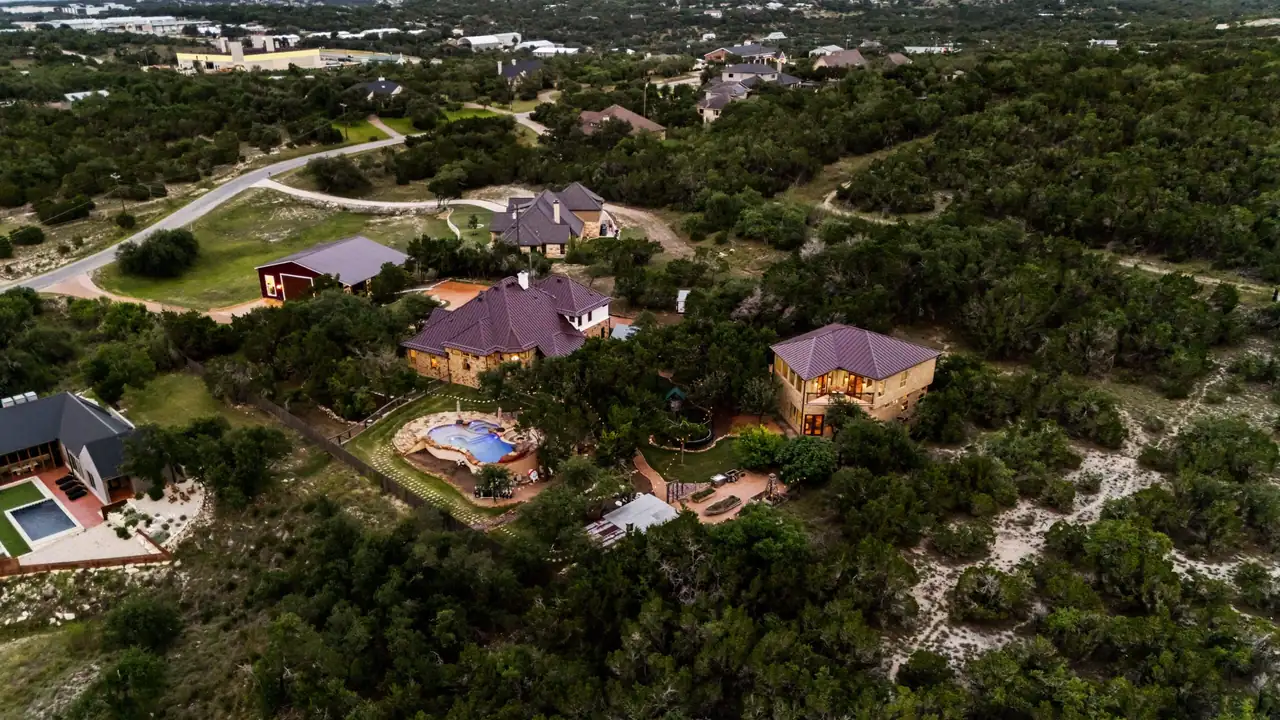
When families build a custom home in the Texas Hill Country, the main house is rarely the whole picture. Wide acreage, a Hill Country backdrop, and the lifestyle that comes with it naturally lead to the question: what else do we want on this property? Pools, barns, and casitas have become the most requested luxury home add-ons in Hill Country, and for good reason — each one brings a specific combination of function, lifestyle value, and long-term return on investment that few other upgrades can match. Done right, these features don’t just complement the main house; they transform a property into something that genuinely feels like a private retreat.
Pools: More Than a Way to Beat the Texas Heat
Let’s be honest — in a Hill Country summer, a pool isn’t a luxury. It’s how you survive the season with your sanity intact. From late May through September, the pool becomes the center of daily life for most families. Kids burn energy, adults decompress, and evenings around the water turn into the kind of low-key gatherings that are the best part of living out here.
A Necessity in the Texas Climate
Central Texas summers regularly hit triple digits for weeks at a stretch. A pool makes the backyard usable when it would otherwise be uninhabitable. Families who build without one often add it within the first few years — and they consistently say they wish they’d done it during original construction, when trenching, grading, and landscaping could have been coordinated instead of redone.
Design That Works with the Hill Country Landscape
Pool design in the Hill Country calls for an approach that treats the landscape as a partner rather than a backdrop. Infinity edges overlooking cedar valleys create a visual effect that’s genuinely stunning. Pools framed by live oaks and limestone outcroppings look like they were always there. The materials you choose — stone coping, cool-underfoot decking, natural boulders for water features — should reinforce the connection between the pool and the land it sits on rather than contrast with it.
Features Families Actually Use
- Tanning ledges — A shallow (6–12 inch) ledge is one of the most used features in family pools. Kids play on them, adults lounge with their feet in the water, dogs cool off without swimming
- Waterfalls and grottos — Natural stone waterfalls tie the pool to Hill Country aesthetics and mask the sound of pool equipment
- Integrated hot tubs — Extends pool season into cooler months; a separate heatable spa is a feature families use consistently year-round
- Swim-up bars — For properties designed for entertaining, a sunken bar counter creates a social focal point
- Smart controls and automated cleaning — Automated systems reduce maintenance burden significantly; robotic cleaners and remote-control automation are worth every dollar
Connecting the Pool to the Outdoor Living Area
A pool that sits in isolation is less useful than one integrated into the covered outdoor living space. Positioning the pool adjacent to a covered porch or outdoor kitchen means you can move fluidly between cooking, eating, and swimming without feeling like you’re navigating three separate zones. It’s a site planning detail that costs nothing extra to get right during design and makes an enormous difference in how the property lives.
Barns: Functional Structures With Serious Character
Hill Country acreage practically calls for a barn. Even for families without livestock, the barn fills a role that nothing else on the property can: serious covered space for equipment, projects, events, and everything that doesn’t fit inside the main house.
More Than Storage
The perception of barns as purely utilitarian structures is outdated. Modern Hill Country barns are events spaces, finished workshops, hobby studios, and sometimes fully equipped secondary residences. They’re one of the most versatile structures on a property, and their use evolves dramatically over time as family needs change.
Types of Barns We Build Most Often
- Traditional Pole Barns — Simple, efficient, and cost-effective. Ideal for equipment storage, hay, and basic utility. Can be expanded or finished later
- Luxury Finished Barns — Climate-controlled interiors, polished concrete floors, full electrical, and sometimes plumbing. These become the property’s entertainment hub — the place where big parties, family reunions, and events happen
- Barndominiums — A barn with living quarters built in or above. Increasingly popular for guest accommodations, caretaker housing, or rental income on larger properties
- Horse Barns — Designed specifically for equestrian use: stalls, tack rooms, wash areas, proper ventilation, and run-in sheds adjacent to the structure
- Combination Shops/Barns — A hybrid structure with a finished workshop area on one end and open barn storage on the other. Popular with hobbyists, contractors, and anyone with serious equipment
Material and Design Choices
One of the most important decisions for any barn is how it relates visually to the main house. Matching the stone, metal roofing, and paint palette creates a unified property where every structure feels intentional. Clients who want the barn to feel more traditional sometimes choose a contrasting approach — weathered wood siding, a classic red metal roof, or a gambrel roofline — and when done well, that contrast gives the property real character. Either direction, the barn becomes a defining visual feature of the land.
Casitas: The Most Versatile Add-On on the Property
If we had to pick one add-on that consistently delivers the most long-term value — in lifestyle, financial return, and flexibility — it would be the casita. A well-designed guest house does things for a property that no other structure can replicate. We’ve written a full post on why casitas are such a strong investment if you want the deeper dive, but here’s the core case.
Why Casitas Are in High Demand
The shift toward multi-generational living has driven casita demand significantly. Aging parents who want proximity but not the loss of independence. Adult children returning home who need their own space. Extended family who visit for weeks at a time and need privacy from the main household. A casita solves all of these situations elegantly in a way that a guest bedroom simply cannot.
In markets like Dripping Springs, Wimberley, and Driftwood, casitas also carry genuine short-term rental appeal on the right properties. A well-designed Hill Country casita can generate meaningful income during periods when it’s not being used by family.
Design Considerations for a Casita
The best casitas feel like complete small homes rather than expanded hotel rooms. Even a compact 600–800 square foot casita benefits enormously from:
- A covered porch with its own view and seating area
- A small kitchen or kitchenette for independence from the main house
- A bedroom with adequate closet space for extended stays
- A full bathroom, not a half bath
- Its own HVAC zone so guests control their own comfort
- Sound separation from the main house — especially important for late-night guests or early-rising grandchildren
Casitas can be attached to the main house via a covered breezeway — which is visually elegant and keeps guests connected to the main structure — or built as fully detached structures, which provides the most independence and privacy.
Long-Term Value of a Casita
The real power of a casita is that its use evolves. It starts as a guest suite. It becomes a home office when remote work takes over. It transitions into a teen retreat when kids hit high school. Eventually it may become a retirement apartment for an aging parent. Few investments on a property remain this useful across so many different stages of life.
How These Features Work Together
The real magic on a Hill Country property happens when these add-ons are designed as a cohesive whole rather than individual projects bolted on over time. A pool connected to a large covered outdoor kitchen and porch. A barn framed in the background against the treeline. A casita tucked to one side with its own landscaping and approach. When everything is planned from the start with the overall property in mind, the result feels like a complete lifestyle destination rather than a house with some extra stuff around it.
At Ridge Rock Builders, we think about the whole property during every project. That includes how the structures relate to each other visually, how traffic flows between them, how utilities are most efficiently run, and how each feature will be used in five and ten years — not just at move-in. See examples of properties we’ve completed on our projects page, and read about our end-to-end process in our post on the Ridge Rock approach from blueprint to move-in.
Planning and Budgeting for Add-Ons
The most cost-effective time to build any add-on is during original construction. Site work — grading, trenching for utilities, landscaping disruption — costs money. When these activities are coordinated across all structures at once, you avoid paying for them multiple times. Concrete trucks, equipment mobilization, and subcontractor scheduling are all more efficient when planned as part of a complete project.
That said, many clients add features in phases as budget allows. If that’s your situation, we’ll design the property so additions are straightforward — pre-running conduit and plumbing stubs to future build sites, grading with future drainage in mind, and locating the main house to preserve the best sites for future structures. Get a build estimate that includes your planned add-ons so you can see the full picture and decide how to phase the work intelligently.
Frequently Asked Questions
When is the best time to add a pool, barn, or casita — during construction or later?
During original construction is almost always more cost-effective. Site work, utility trenching, and landscaping can be coordinated once instead of repeated. Grading for a pool, for example, can be done alongside foundation work. Adding these features years after initial construction is definitely possible, but expect to pay a meaningful premium for the repeated site disruption and mobilization.
Do pools, barns, and casitas add to resale value in the Hill Country?
Yes, consistently. In the Hill Country luxury market, buyers actively look for properties with these features. Pools are particularly strong value drivers in the summer-heavy Texas market. Casitas add value directly through their square footage and versatility. Barns and shops are major selling points for buyers seeking acreage properties with functional infrastructure. These aren’t just lifestyle additions — they’re real estate investments.
What size casita makes the most sense?
For most families, 600–900 square feet hits the sweet spot — large enough for comfortable extended stays, small enough to maintain efficiently. If the casita will serve as a rental unit, a full kitchen is important. For a guest suite used by family, a kitchenette may be sufficient. We’ll help you think through the intended use cases to right-size the structure.
What kind of barn is right for a property without livestock?
Most non-equestrian clients do best with either a finished shop/entertainment barn or a combination structure with utility storage on one end and a finished space on the other. The finished side handles tools, hobbies, and overflow storage from the main house. The utility side handles equipment, trailers, and outdoor gear. Together, they give you the covered square footage that acreage life almost always demands.
Can we build a casita and rent it out on Airbnb or VRBO?
Many clients do. This depends on local short-term rental regulations, which vary by county and ETJ jurisdiction in the Hill Country. We’ll advise you on current rules in your specific location. Properties in unincorporated Hays or Travis County often have more flexibility than those within city limits. A casita designed with rental in mind should include dedicated parking, a full kitchen, private exterior access, and strong Wi-Fi infrastructure.
Do you build all three — pool, barn, and casita — on the same project?
Absolutely. We handle full-property development that includes the main house and all supporting structures. Building everything at once gives you the most cohesive design result and the best overall value. Call us at (512) 294-9579 to talk through your property vision and what a complete build would involve.
Ready to Start Your Project?
At Ridge Rock Builders, we specialize in custom homes, remodels, barns, shops, and casitas throughout the Texas Hill Country. Whether you’re still exploring your options or ready to break ground, we’d love to talk.
Get a free build estimate or call us at (512) 294-9579 to start the conversation.


