
Why Hill Country Homeowners Are Adding Shops and Workshops to Their Properties
Drive down almost any county road outside Dripping Springs or through the rural stretches of Wimberley and Spicewood, and you’ll notice something: the properties that look most “lived in” — the ones that feel complete — almost always have a shop building somewhere on the land. It might be a steel building behind the house, a big timber workshop visible from the road, or a stone-and-metal structure that matches the main home’s aesthetic perfectly. Over the past several years, detached shops and workshops have gone from a nice-to-have to one of the most requested add-ons we see from clients building in the Texas Hill Country. Here’s why — and what you need to know if you’re thinking about adding one to your property.
What’s Driving the Trend
The shift toward home-based shop buildings isn’t just about having extra storage space. It reflects something real about how people who move to the Hill Country want to live.
Space that production homes don’t provide
Most people moving from Austin or another metro area to a rural or semi-rural Dripping Springs property are escaping a lifestyle that didn’t have room for the things they actually love doing. Woodworking, automotive restoration, blacksmithing, hunting prep, agricultural equipment maintenance — these activities require space, dedicated power, ventilation, and floor surfaces you don’t mind ruining. A shop gives you all of that in a building that doesn’t affect the livability of your main home.
Remote work and the home office shop hybrid
We’ve built a lot of what we call “man caves with WiFi” — front half finished as a professional home office (HVAC, fiber internet, sheetrock), back half a raw working shop. This hybrid layout has been popular since 2020 and shows no signs of slowing. The separation it creates between work and home life is something a dedicated room inside the house can’t fully replicate.
Land investment and self-sufficiency
Hill Country landowners tend to be DIY-minded. They’re maintaining wells, managing drainage, keeping tractors and UTVs running, and handling a lot of the property upkeep themselves. Without a proper shop, all of that happens in the driveway or borrowed space. A dedicated agricultural or mechanical shop with roll-up doors, a concrete slab, and a parts storage system turns property ownership from a series of inconveniences into something genuinely enjoyable.
Types of Shop Buildings We Build
Not all shop buildings are the same, and the right type depends on how you plan to use it. Here’s a breakdown of the most common configurations:
Basic utility shop / storage building
A simple metal building with a concrete slab, single or double roll-up door, basic electrical (lights and outlets), and minimal finish work. This covers most storage and light-use mechanical needs. Size range: 24×30 to 30×40. Cost range in the Hill Country: $35,000–$65,000 depending on size, site prep, and whether you’re adding a lean-to or covered awning.
Working workshop
Built for serious use — a woodworker, metalworker, or serious hobbyist. Includes 220V electrical service for heavy tools, upgraded LED shop lighting, concrete floor with slope-to-drain, ventilation for dust or fume management, potentially a spray booth or specialized area. Insulation is important here for temperature control and noise. Size range: 30×40 to 40×60. Cost range: $65,000–$130,000 depending on finish level and systems included.
Automotive shop / garage
Designed around vehicle access and work. Multiple roll-up doors (10- or 12-foot clearance), vehicle lift-capable slab (typically 6-inch reinforced), compressed air plumbing in the walls, oil/fluid containment, and good drainage. Often includes a second floor or mezzanine for parts storage. If you’re storing or working on trucks, RVs, or farm equipment, ceiling height matters — we’ve built shops with 14- and 16-foot sidewalls specifically for high-clearance vehicles. Cost range: $75,000–$150,000+
Office/workshop combo
The hybrid building we mentioned earlier. Finished front section with HVAC, insulation, sheetrock, flooring, and bathroom — functions as a legitimate home office, studio, or bonus living space. Rear section is a raw shop. These are popular with clients who work from home and want to get out of the house without going far. Cost range: $90,000–$180,000 depending on the finished square footage and system complexity.
Barn and equipment storage
For ranches, small farms, and horse properties. These prioritize clear span space, tall doors, and durability. Cost tracks similarly to a utility shop for basic equipment barns; more elaborate horse barns with stall configurations and run-in sheds run higher. Contact us for specifics on agricultural structures.
Site Considerations in the Hill Country
Building a shop in Central Texas isn’t just about picking a building style. The land itself creates challenges and opportunities that shape every decision.
Terrain and site prep
Hill Country terrain is rocky, often uneven, and sometimes caliche-dense. Site preparation — clearing, grading, rock excavation — can be the single biggest variable in a shop building cost. We’ve had projects where the slab pad required minimal work, and others where limestone ledge required a rock saw to achieve a level pad. Until you’ve had a site assessment, treat any cost estimate as provisional. We assess every site before giving a final number.
Septic and utility access
If the shop includes a bathroom, you’ll need to address waste: either tie into the existing septic system (which may require a capacity evaluation) or run a new dedicated system. Electrical service for a large shop may also require a panel upgrade or new underground feed. Factor both into your budget upfront.
Setbacks and permits
Unincorporated Hays County standard setbacks: 40 feet front, 10–15 feet sides, 25 feet rear — though these vary by zoning and lot size. Some shop buildings trigger a commercial electrical permit. We handle all permitting for every shop project we build — it’s part of what you’re paying for with a licensed GC versus a metal building company that erects only.
Design and Aesthetics: Making the Shop Look Like It Belongs
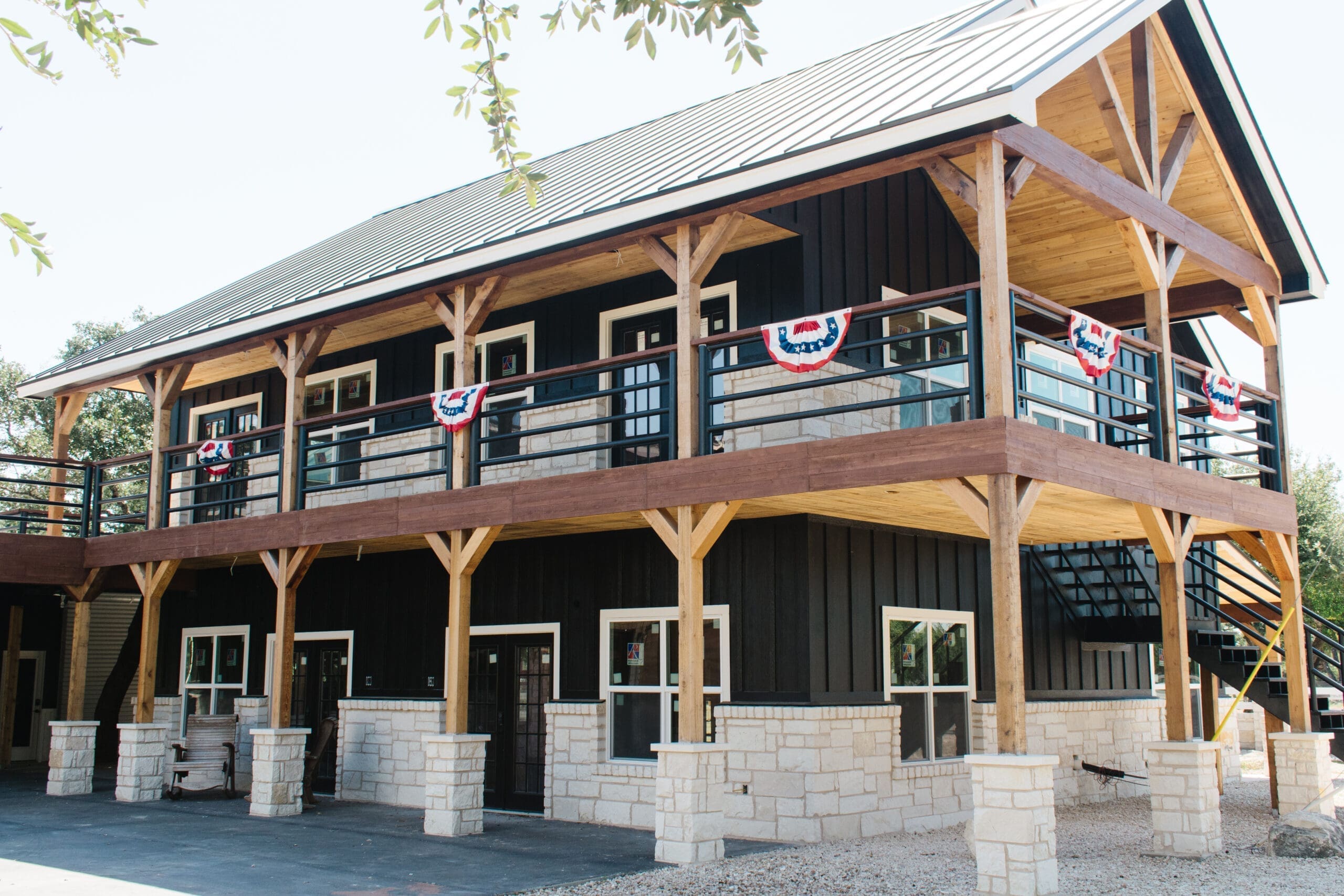
One of the things we’re most proud of in our shop work is the attention to aesthetics. A shop doesn’t have to be an eyesore on your property. Some of the most visually compelling structures we’ve built are shop buildings that pick up the materials and character of the main house — standing seam metal roofing, stone or cedar siding accents, wood-framed windows, a matching front door.
When building a home and shop on the same property, there’s a real opportunity to treat them as a cohesive compound rather than a house and a shed. We’ve done projects where the shop is intentionally visible because it’s handsome enough to be a feature of the property. That approach takes more budget but produces a property that holds value differently than a utility box in the back corner.
If you’re planning a custom home and know you want a shop, talk to us about both at the same time. Get a free build estimate that covers both structures together — we can often find efficiencies in site work, foundation, and utility installation when both projects are planned in tandem.
Return on Investment: Does a Shop Add Property Value?
In the Hill Country market, quality outbuildings consistently add measurable value. Buyers here are actively looking for functional structures, and agents in the Dripping Springs and Wimberley markets regularly see properties with quality shops sell faster and at a premium. Build it right, get it permitted, and it becomes an asset. An unpermitted or poorly built shop can complicate a sale instead.
Check out our blog for more on building on Hill Country land, and visit our Dripping Springs custom homes page to see more of our work.
Frequently Asked Questions
Do I need a permit to build a shop or workshop in Hays County?
Yes, in most cases. Any structure with electrical, plumbing, or HVAC requires a permit in Hays County. Even basic accessory structures above a certain square footage threshold require a building permit. The permitting process for a shop is simpler than for a custom home but shouldn’t be skipped — unpermitted structures can create significant problems when you try to sell the property or file an insurance claim.
What size shop building do I need?
Think bigger than you think you need. We’ve never had a client tell us their shop is too large. We’ve had plenty tell us they wish they’d gone 10 or 20 feet longer. A good starting point: think about the largest piece of equipment you’ll ever store or work on, plan the door opening and floor space around that, and then add 30% for everything else that accumulates over time.
Can a shop building include a bathroom?
Yes, and we recommend it for any shop you’re going to spend significant time in. Adding a bathroom during initial construction is much more cost-effective than adding one later. It typically adds $8,000–$15,000 to the project cost and is worth every dollar if the shop is going to be a real workspace.
How long does it take to build a shop in the Hill Country?
A straightforward metal building with basic finishes takes 8–14 weeks from permit approval to completion. A more finished office/workshop combo or a building with complex site prep can take 16–24 weeks. If you’re building the shop alongside a custom home, we sequence the construction to minimize site logistics conflicts.
What’s the difference between hiring a general contractor and a metal building company for a shop?
A metal building company (pole barn or steel building erector) typically handles design, fabrication, and erection of the structure — but they don’t typically handle site work, foundations, electrical, plumbing, or permitting. A general contractor like Ridge Rock manages the full scope: site prep, foundation, structure, all systems, finishes, and permit close-out. For a simple utility building, a metal building company may be sufficient. For anything with electricity, plumbing, HVAC, or finished interior spaces, a GC is the right call.
Can I add a shop to my property after my home is already built?
Absolutely. We build plenty of standalone shop projects for existing property owners who are ready to add the structure they always planned. The process is the same as building new — site assessment, design, permit, build. The main difference is that we’ll need to coordinate around the existing home and any underground utilities already on the property.
Ready to Start Your Project?
Whether you’re planning a shop alongside a new custom home or adding one to your existing property, we’d love to walk through the options with you. We build shops, workshops, barns, and office/workshop combos all across the Hill Country — and we know how to make them look great and work hard.
Get a free build estimate or call us at (512) 294-9579. We work in Dripping Springs, Austin, Bee Cave, Wimberley, Spicewood, Driftwood, and Lakeway.