

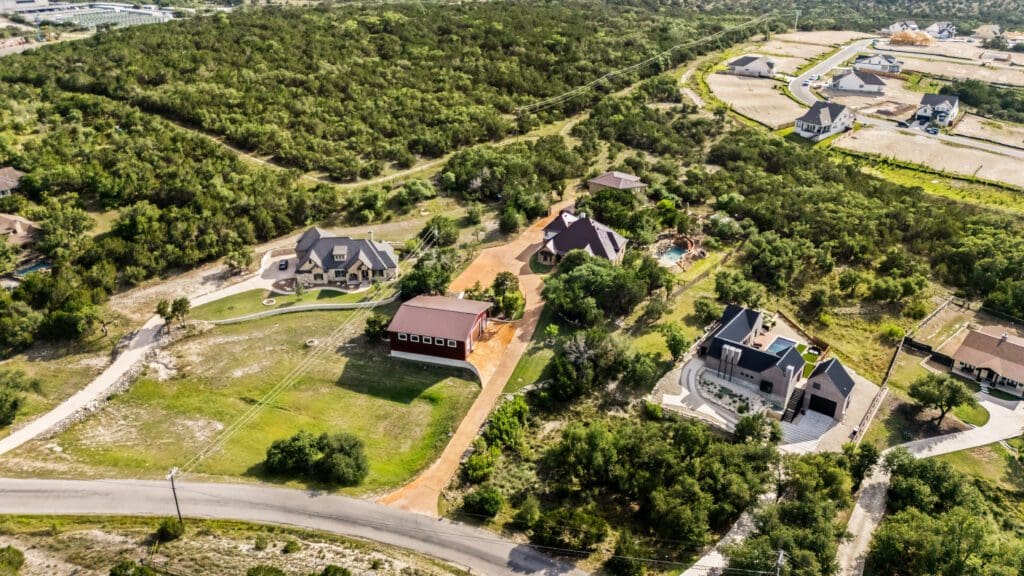
There’s something fundamentally different about building on acreage in the Texas Hill Country compared to building on a standard subdivision lot — and most of that difference shows up in the planning phase, long before the first nail is driven. The freedom of space is real and extraordinary, but so are the logistical challenges that come with it. Getting those challenges right from the beginning is what separates a smooth build from a frustrating one.
The Unique Opportunity of Acreage Builds
When you’re building on five, ten, or twenty-plus acres, you’re not just building a house — you’re designing a lifestyle. The decisions you make about where to place the home, how to orient it, and what to plan for down the road will shape how you experience your property for decades.
Siting and Orientation Matter More Than You Think
On a subdivision lot, your builder has roughly one option for where to put the house. On acreage, you have dozens. That freedom is a gift, but it requires real thought. The best home placement considers:
- Views from key living areas — where do you want to see the sunrise? The sunset over the cedar breaks?
- Prevailing wind direction for natural ventilation (south and southeast breezes are common in the Hill Country)
- Solar orientation — a home with the main glass facing south gets passive solar benefit in winter without overheating in summer
- Proximity to the road or entry for practical daily use
- Topography and drainage — you want the home above any drainage flow, not in it
- Future outbuildings — barns, shops, casitas, and pools should all factor into initial siting
These decisions are a big part of why working with a builder who knows Texas acreage is so important. It’s not just about the structure — it’s about understanding the land.
Utilities on Acreage: What You’re Really Getting Into
In town, water, sewer, electricity, and sometimes gas are waiting at the curb. On acreage, you’re often building those systems from scratch. This isn’t necessarily a problem — but it’s a cost and timeline factor that every acreage buyer needs to understand going in.
Water Wells
Most acreage properties in the Hill Country rely on private water wells. Well depth, yield, and water quality vary significantly by location — some properties have excellent shallow wells, others need to drill 400–600 feet to hit reliable water. A water quality test is essential before you build, and you’ll also need to plan for pressure tanks and potentially water treatment systems depending on what the test reveals.
Septic Systems
Without municipal sewer access, you’ll need a septic system. The type of system required depends on your soil percolation rates, lot size, and local health department regulations. Aerobic septic systems are common in the Hill Country and require maintenance contracts, so budget accordingly. Placing the septic system correctly relative to the home, the well, and any future structures is a critical planning step.
Electrical Service
If your property doesn’t already have electrical service, extending it can range from straightforward to expensive depending on how far the nearest transformer or line is. Some remote Hill Country properties have been candidates for solar-plus-battery systems, which can be cost-competitive with long line extensions. Either way, this needs to be planned and budgeted early.
Roads, Driveways, and Site Access
Getting to your house is as important as the house itself — and on acreage, it involves real planning and real cost.
A long driveway needs to be properly graded, drained, and surfaced. The Hill Country’s rocky terrain means you may need to cut through caliche, manage drainage crossings, and address erosion on sloped sections. If you plan to add structures later — a barn, shop, or guest house — design your access now so heavy equipment can reach those future building sites without tearing up finished work.
A few things we address during driveway and access planning:
- Culverts and drainage crossings at low spots
- Turnaround areas for emergency vehicles (required by some county fire codes)
- Gravel, concrete, or asphalt surfacing based on length, grade, and budget
- Gate placement, including conduit for future automatic gate systems
- Utility trench routing under or alongside the driveway
Design Freedom on Acreage Builds
Here’s the good news: all that logistical complexity pays off in extraordinary design freedom. When you’re not constrained by a 50-foot lot width, HOA covenants, and zero-lot-line setbacks, you can build the home you actually want.
Detached Structures and Multi-Use Property Planning
Acreage is where you can add a detached casita for visiting family or aging parents, a working barn, an equipment shop, or a guest cabin without compromising the main home’s character. Many of our clients in Dripping Springs and Spicewood start with the main home and add outbuildings in phases as budget allows. Planning the infrastructure during the initial build — utility stubs, access roads, electrical capacity — makes those future phases much simpler. You can learn more about the possibilities in our post on pools, barns, and casitas as Hill Country home add-ons.
Architectural Scale and Style
Acreage allows for architectural choices that simply aren’t possible on small lots. Longer, lower ranch-style profiles that hug the land. Wraparound porches that take in views in multiple directions. Detached garages with motor courts. Homes that are designed to disappear into the landscape rather than dominate it. These are the kinds of builds we love doing at Ridge Rock Builders.
Common Mistakes Buyers Make on Acreage
Even experienced homebuyers can get tripped up by acreage-specific issues. Here are the ones we see most often:
- Not testing the well early: Water quantity and quality should be confirmed before you finalize your land purchase or build plans
- Underestimating site development costs: Land clearing, caliche removal, grading, septic, well drilling, and driveway costs can easily add $80,000–$200,000+ depending on conditions
- Ignoring drainage: That low spot that “only floods when it really rains” will flood during construction and potentially threaten your foundation. We always do a thorough drainage analysis before siting the home
- Not planning for future structures: Clients who add a barn or shop two years later and didn’t plan for it often end up with awkward access, costly utility extensions, and compromised layouts
- Skipping a perc test: Before you finalize any acreage purchase intended for building, make sure the property can support the septic system you need
Why Builder Experience on Acreage Matters
Not every custom builder has experience working on acreage properties, and it shows. Acreage builds require coordination of multiple site contractors — well drillers, septic installers, electrical co-ops, road graders — in addition to the standard construction trades. A builder who isn’t comfortable managing that scope will leave you filling gaps yourself.
Ridge Rock Builders has completed custom homes on everything from flat open meadows to rocky, tree-covered hillsides across Dripping Springs, Wimberley, Driftwood, and beyond. We know how to sequence site work, coordinate utilities, manage erosion during construction, and deliver a finished home that sits beautifully on its land. You can read more about our process from blueprint to move-in and see exactly how we manage complexity from day one.
What a Well-Planned Acreage Build Delivers
When it’s done right, an acreage build in the Texas Hill Country delivers something no subdivision home can match: genuine privacy, connection to the land, and a property that functions as an entire lifestyle rather than just a place to sleep. The key is approaching it with eyes open, realistic budgets for site development, and a builder who’s done it before.
If you’re considering land in areas like Spicewood or the Wimberley Valley, we’re happy to walk the land with you and help you understand what a build on that property would really involve before you commit. And if you’re still in the early stages, our post on what to know once you’ve decided to build a custom home is a great place to start.
Frequently Asked Questions
How much does it cost to build on acreage in the Texas Hill Country?
Site development costs on acreage typically run $80,000–$200,000+ depending on how far utilities need to be extended, how much clearing and grading is required, driveway length, and septic and well costs. This is in addition to the home construction cost itself. Getting a realistic site development estimate early is essential for accurate overall budgeting.
Do I need a well on an acreage property in the Hill Country?
Most acreage properties outside incorporated city limits don’t have access to municipal water, so yes — a private water well is typically required. Well depth and yield vary by location. We strongly recommend having a well drilled and water tested before finalizing your building plans.
What type of septic system is used on Hill Country acreage?
Aerobic treatment units (ATUs) are common in Hays County and surrounding areas, particularly where soil conditions don’t support a standard gravity-fed system. They require a maintenance contract and periodic inspections. Your builder and a licensed septic designer will determine the right system based on a soil evaluation and county requirements.
How long does an acreage build take compared to a subdivision build?
Site development adds time to the front end of an acreage build. Between land clearing, well drilling, septic design and installation, utility coordination, and driveway construction, you should budget 2–4 months of pre-construction site work before the home build begins. Total project timelines for acreage custom homes typically run 12–18 months from contract to move-in.
Can I add a barn or casita to my acreage property later?
Absolutely — and planning for it now saves significant money later. During the main build, we can stub out utility lines to future building sites, size the electrical service to accommodate additional structures, and design driveway access to reach those areas. This avoids costly retrofits when you’re ready to add the next structure.
What’s the difference between building on acreage and building in a subdivision?
Subdivision lots come with infrastructure already in place — water, sewer, electricity, paved roads. On acreage, you’re providing all of that yourself. You also have far more design freedom, fewer HOA constraints, and more flexibility in what you can build. The trade-off is higher upfront site development costs and more coordination complexity.
Ready to Start Your Project?
At Ridge Rock Builders, we specialize in custom homes, remodels, barns, shops, and casitas throughout the Texas Hill Country. Whether you’re still exploring your options or ready to break ground, we’d love to talk.
Get a free build estimate or call us at (512) 294-9579 to start the conversation.