

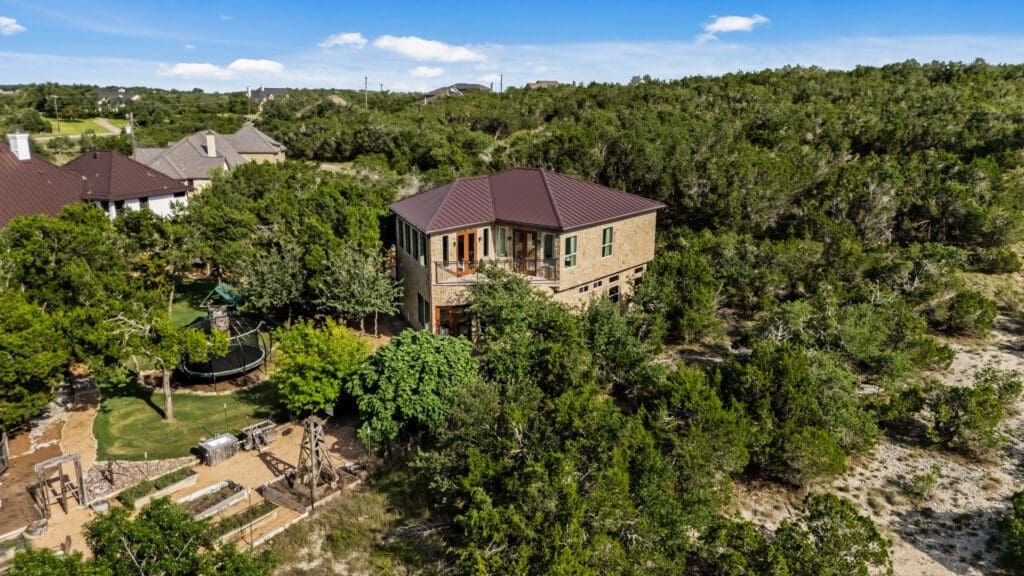
When you’re building on acreage in the Texas Hill Country, septic, well water, and utilities aren’t afterthoughts — they’re foundational decisions that affect your build cost, your timeline, and how you’ll live on the property for decades. Unlike building in a city subdivision where water, sewer, gas, and power are already at the curb, rural land requires you to create your own infrastructure. Here’s what you need to budget, plan, and understand before you break ground.
Septic Systems: Types, Costs, and What Drives the Decision
If your property doesn’t connect to a municipal sewer system — and most rural Hill Country tracts don’t — you’ll need an on-site sewage facility (OSSF), more commonly known as a septic system. The type of system you can install depends on your soil conditions, lot size, setback requirements, and what your county health department approves.
Common Septic System Types
- Conventional aerobic septic system: The most common type in the Hill Country. Uses a treatment tank, aerobic treatment unit (ATU), and a spray or drip distribution field. Typical installed cost: $12,000–$25,000. Requires regular maintenance contracts (spray heads need servicing).
- Standard septic with drainfield: Works where soils allow adequate percolation. Generally less expensive than aerobic systems, but soils in much of the Hill Country — particularly rocky or clay-heavy soils — often don’t allow this option.
- Low-pressure dose (LPD) system: Used on sites where conventional gravity flow doesn’t work. Distribution is pressurized to spread effluent more evenly. Cost is typically between a conventional and aerobic system.
- Alternative systems: Mound systems, drip irrigation systems, and others may be required on challenging sites. Can run $25,000–$40,000 or more.
What Drives Septic Costs Up
- Rocky soil requiring blasting or heavy excavation
- Limited space for a drainfield due to lot size or setbacks
- High water table in certain areas
- Distance from the home to the most suitable installation site
The permitting process for septic in Hays County and Travis County involves a site evaluation, soil testing, and plan approval by the county or an authorized agent. Before you buy land, it’s smart to confirm that the parcel has a viable septic site — we cover this in our land-buying guide for the Hill Country.
Drilling a Water Well in the Texas Hill Country
If your property isn’t served by a water supply corporation or municipal water provider, a private water well is your most common option. The Hill Country sits above the Edwards Aquifer and the Trinity Aquifer — both well-documented groundwater sources, but depth and yield vary considerably by location.
What to Expect From Well Drilling
- Depth: Wells in Hays and Travis County typically range from 200 to 700 feet deep, though some areas require drilling to 1,000 feet or more. Shallower wells cost less; deeper wells cost significantly more.
- Drilling costs: Expect to pay $25–$60 per foot for drilling, plus equipment and installation. A 400-foot well with pump, pressure tank, and wellhead can run $15,000–$30,000 or more.
- Water testing: Once your well is drilled, have the water tested for bacteria, minerals, hardness, and any contaminants. Treatment systems (softeners, filtration, UV purification) add $1,500–$8,000 depending on what the water needs.
Things to Research Before Drilling
- Talk to neighbors about their well depth and yield — this is public information in Texas through the TCEQ.
- Contact the Edwards Aquifer Authority (EAA) or Hays Trinity Groundwater Conservation District depending on your property location.
- Ask your driller about typical yield for the formation in that area — you want at least 2–3 gallons per minute for a residential home.
Rainwater Harvesting as an Alternative or Supplement
Texas has some of the most permissive rainwater harvesting laws in the country. Collecting and using rainwater is not only legal — it’s encouraged. In areas where well water is deep or expensive, rainwater collection systems are an increasingly popular option.
- Potable systems: With proper filtration (UV sterilization, sediment and carbon filters), a rainwater collection system can provide all the drinking and household water a family needs. A whole-house potable system typically costs $15,000–$35,000 depending on tank size and filtration complexity.
- Non-potable systems: Less expensive systems capture water for irrigation, livestock, or fire suppression without full potable treatment.
- Tank sizing: A 10,000–20,000 gallon cistern is typical for a primary residence. Fiberglass and polyethylene tanks are common; concrete tanks are also used.
Some homeowners pair a rainwater system with a well — using well water for daily household use and harvested rainwater for irrigation and other non-potable needs. This dual-source approach is popular in water-conscious communities throughout Wimberley, Driftwood, and Spicewood.
Electrical Service: Getting Power to Your Property
Most rural properties in the Hill Country are served by Pedernales Electric Cooperative (PEC), Bluebonnet Electric, or LCRA Transmission. If your land doesn’t already have electric service, you’ll need to coordinate a service extension with the relevant co-op.
- Short extensions (under 200 feet): Often included or low-cost through the utility.
- Longer extensions: Costs can run $5–$15 per foot for overhead lines, significantly more for underground service. A 1,000-foot extension to a remote lot could run $10,000–$20,000 or more.
- Temporary construction power: You’ll need a temporary power pole during construction. Budget $1,500–$3,000 for this separately.
- Solar: For very remote properties, off-grid solar with battery storage is increasingly viable. Upfront costs are higher, but you eliminate the utility extension expense and monthly bills. Whole-home solar systems run $30,000–$80,000 or more depending on size and battery capacity.
Propane vs. Natural Gas for Rural Properties
Natural gas lines rarely extend to rural Hill Country tracts. Propane is the standard for gas-powered appliances — ranges, water heaters, fireplaces, and whole-home generators. Here’s what to know:
- Tank sizing: Most residences use a 500–1,000 gallon tank. Larger homes with gas generators or pool heaters may need 1,000+ gallons.
- Tank options: You can lease a tank from a propane provider or purchase one outright. Owning your tank gives you more flexibility on fuel pricing.
- Propane costs: Expect to pay $1.50–$3.50 per gallon depending on market conditions and delivery schedule. Budget $1,500–$3,500 per year for a typical household.
- Propane line installation: The underground line from the tank to the house is typically installed by your plumber and is part of standard rough-in costs.
Internet and Connectivity in Rural Hill Country
This is one of the most frequently overlooked items in rural land purchases — and one of the most impactful for daily life. Connectivity varies dramatically even within a few miles in the Hill Country.
- Fiber: Available in some Dripping Springs and Wimberley areas. Fastest and most reliable option. Check with Spectrum, AT&T Fiber, or local providers for specific address availability.
- Fixed wireless: Provided by companies like Hill Country Wireless, Forerunner, and others. Decent speeds (25–100 Mbps) where signal is available. Requires a line-of-sight dish installation.
- Starlink: SpaceX’s satellite internet service has become the go-to solution for remote Hill Country properties. Speeds of 50–250 Mbps, reliable performance, and available essentially anywhere. Hardware runs about $600; monthly service is around $120.
- Cell-based (LTE/5G): Useful as a backup or primary option where cell coverage is strong. Check carrier coverage maps for each specific property — coverage can be dramatically different a quarter mile apart.
Budgeting for Site Utilities: The Numbers That Surprise Buyers
One of the most common budget surprises for first-time rural builders is the total cost of site infrastructure. When you build in a city subdivision, utilities are already there. On rural acreage, you’re starting from scratch.
Here’s a realistic budget range for a complete utility setup on a rural Hill Country lot:
- Septic system: $12,000–$30,000
- Water well (including pump and pressure tank): $15,000–$35,000
- Water treatment system: $1,500–$8,000
- Electrical service extension: $3,000–$25,000
- Propane tank and initial fill: $1,500–$4,000
- Temporary construction power: $1,500–$3,000
- Rainwater system (if applicable): $15,000–$35,000
Total site utility costs for a rural property can easily run $35,000–$90,000 or more before you’ve poured a single foundation wall. This is why we strongly encourage clients to get a build estimate early in the process — these costs need to be factored into your total project budget from the start.
Building in the Hill Country is incredibly rewarding. But it requires planning, realistic budgeting, and working with a builder who understands what’s involved. For a deeper look at the land evaluation process before these utility decisions even come into play, read our post on buying land in the Texas Hill Country.
Frequently Asked Questions: Septic, Well Water, and Utilities for Acreage Builds
Can I build a home on land without access to a water well or city water?
Technically, you can use a rainwater harvesting system as your primary water source if it meets Texas TCEQ standards for potable water systems. However, most lenders and some counties require a permitted water supply connection or well as a condition of the construction loan or certificate of occupancy. A rainwater system can supplement but rarely fully replaces a well or municipal connection in lender requirements.
How long does it take to drill a water well in the Hill Country?
The actual drilling typically takes one to three days once a rig is mobilized to your site. Getting on a driller’s schedule can take four to eight weeks depending on demand. Including the permitting, pump installation, pressure tank, and water testing, expect the full well process to take four to twelve weeks from start to finish.
Do I need a septic permit in Hays County before I can build?
Yes. In Hays County, an OSSF (on-site sewage facility) permit is required before construction. The process involves a site evaluation, soil analysis, system design, and permit approval through the Hays County Development Services. Your builder or a licensed septic contractor will typically manage this process, but it needs to start early because the timeline can add several weeks to your pre-construction schedule.
What’s the difference between the Edwards Aquifer and the Trinity Aquifer?
The Edwards Aquifer is a highly productive limestone aquifer that underlies much of Central Texas. The Trinity Aquifer sits beneath it and is also used throughout the Hill Country. Many areas in the Hill Country draw from the Trinity rather than the Edwards. Which aquifer your well taps depends on your specific location and geology. A local well driller will know which formation to target in your area.
Is Starlink good enough for working from home in the Hill Country?
For most remote workers, yes. Starlink typically delivers 50–200 Mbps download speeds with latency suitable for video calls, cloud applications, and standard business use. It’s not perfect — occasional outages during heavy weather and brief buffering can occur — but it has transformed connectivity for rural Hill Country properties where fiber or fixed wireless isn’t available. Many of our clients in Wimberley, Driftwood, and Spicewood use it successfully as their primary internet service.
Can I use a propane generator as a backup for power outages?
Absolutely, and we recommend it. Whole-home standby generators powered by propane are a popular addition in the Hill Country where power outages — particularly during ice storms or severe weather — can last for days. A properly sized standby generator connected to your existing propane supply adds $8,000–$20,000 to your build, but most homeowners in rural areas consider it an essential rather than a luxury.
Ready to Start Your Project?
At Ridge Rock Builders, we specialize in custom homes, remodels, barns, shops, and casitas throughout the Texas Hill Country. Whether you’re still exploring your options or ready to break ground, we’d love to talk.
Get a free build estimate or call us at (512) 294-9579 to start the conversation.