

There is nothing quite like a before-and-after story to make the possible feel real. Whether you are standing on a raw piece of Hill Country land trying to picture the home that should be there, or walking through a dated house wondering if it is worth saving, the distance between where things are and where they could be can feel enormous. Our work as a home remodel and custom build team in Texas is to close that distance — to take what exists and transform it into something that genuinely serves the people who live there. Here are some of the transformation stories that best represent what we do.
From Raw Land to a Family Home
Some of our most dramatic transformations start with nothing but land — cedar, oak trees, grass, rock, and the potential that every piece of Hill Country property holds.
The Starting Point: A Blank Slate
A family buys 10 acres outside of Dripping Springs. The land has views to the south across a limestone valley. There is a cedar-choked dry creek bed in the northeast corner. The driveway approach from the county road is rough caliche. To most people driving by, it looks like a quiet piece of Texas scrub. To an experienced builder, it is a story waiting to be told.
The Process: Reading the Land Before Drawing a Line
Before we draw a single floor plan line, we walk the property. We identify the building envelope — where the home should sit to capture the best views, receive the morning light, stay protected from afternoon western sun, and drain effectively during a heavy rain. We note the prevailing breeze direction, which is critical for covered porch placement. We find the natural cedar clearing that becomes the pool deck. We identify the slope that will allow a walkout lower level.
Then the design work begins: massing the home, orienting rooms, planning the outdoor flow. The floor plan is driven by the land, not imposed on it. Site work starts with selective clearing — we take only what needs to go, leaving the mature live oaks and the natural rock outcroppings that will define the home’s character. Grading, foundation work, utilities from the road — each phase reveals more of what the property will become.
The Result: A Home That Belongs There
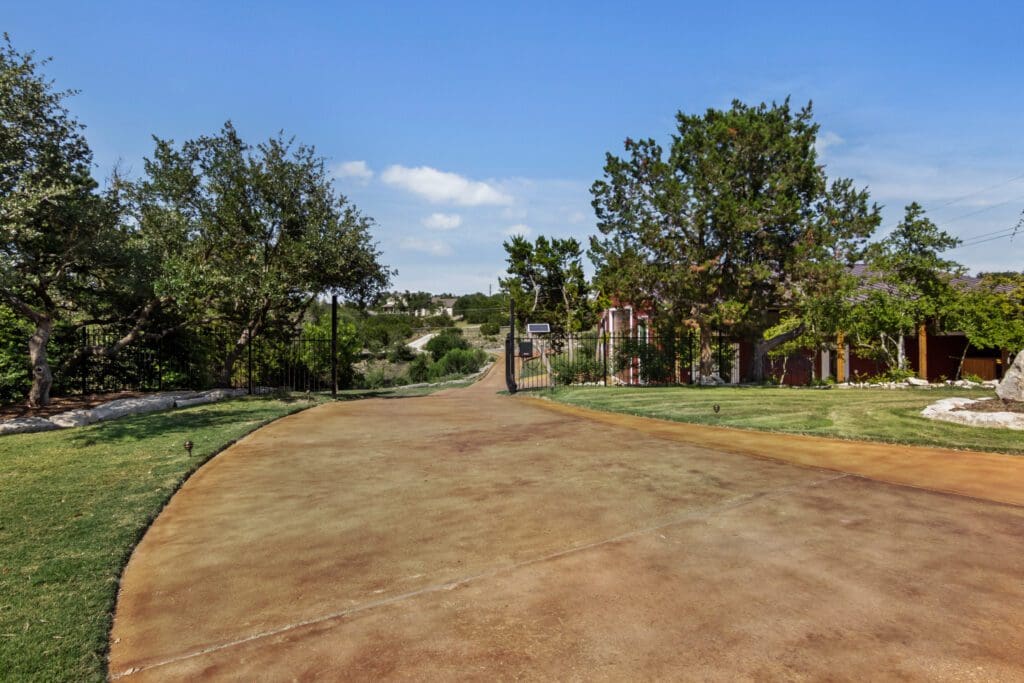
Where there was once open scrub, there is now a limestone home with a standing seam metal roof, a covered porch that runs the full length of the south elevation, a pool positioned to catch the sunset view, and a motor court framed by the oaks that were preserved during clearing. The home looks like it has been there for twenty years. That is the goal. You can see how this kind of site-informed design plays out in our project gallery.
Remodeling the Outdated: When Keeping Is Better Than Replacing
Not every transformation involves a blank piece of land. Some of our most meaningful work happens inside existing homes — houses that have good bones but have not kept pace with how their families have evolved.
The Challenge: A House That No Longer Fits
A family has lived in their home for fifteen years. The floor plan made sense when they moved in, but three kids and a lot of living later, it does not. The kitchen is closed off from the family room, making it impossible to cook and still be part of the action. The master bathroom was fine in 1998 but feels small and dated. The back porch is a 4-foot concrete slab with a metal awning — technically a porch, functionally useless. The home has an HOA and sits on a half-acre lot, so building new somewhere bigger is not on the table.
The Transformation: Thoughtful Surgery, Not Wholesale Replacement
The right approach is not to gut the house — it is to make targeted, high-impact changes that address what is not working while preserving what is. In a project like this, the transformation typically involves:
- Opening the floor plan — removing the wall between the kitchen and family room to create an integrated living space; adding a kitchen island that functions as both prep surface and social bar
- Expanding the primary bath — borrowing square footage from an adjacent bedroom closet to create a proper spa bathroom with a walk-in shower, freestanding tub, and dual vanity
- Building a real outdoor living space — replacing the undersized concrete slab with a proper covered porch: 14 feet deep, tongue-and-groove cedar ceiling, built-in outdoor kitchen, ceiling fans, and a gas fire feature
- Replacing dated finishes throughout — swapping builder-grade oak cabinets and laminate countertops for custom cabinetry and quartzite; replacing carpet with wide-plank engineered hardwood; refreshing all lighting from the ceiling to the fixtures
- Improving energy performance — new windows, attic insulation, and updated HVAC equipment that reduces monthly energy bills and makes every room more comfortable
For bathroom-specific inspiration, our post on stunning bathroom remodel ideas covers what is possible in a complete bath renovation.
The Payoff: The Same Address, A Different Home
When the project is complete, the family does not want to leave for vacation. The house they used to make excuses for — “we are going to fix it up someday” — is now the house they are proud to have people over to. The floor plan finally makes sense. The spaces serve the way they actually live. The porch gets used every evening. That is the transformation that matters most.
Before and After: A Kitchen That Changed Everything
Sometimes the most dramatic transformation in a whole-house remodel is the kitchen — because the kitchen is where most family life happens, and a bad kitchen is a constant source of friction.
Before: Functional but Forgettable
Original oak cabinets to the ceiling, laminate counters, a peninsula that blocked light and traffic flow, a window over the sink with a cheap vinyl casement looking at the fence. No pantry. An appliance package that was fine for 2005. The kitchen worked, but it was never where anyone wanted to be.
After: A Kitchen Worth Gathering In
- Custom shaker cabinets in an aged white finish — to the ceiling, with a proper crown and glass-front uppers on either side of the range
- Quartzite countertops with a honed finish — durable, beautiful, and low-maintenance for a family with three kids
- A 10-foot island replacing the old peninsula — opens the sightlines to the family room and creates a true gathering hub
- A 48-inch range with a custom plaster hood — the focal point of the whole kitchen
- A dedicated walk-in pantry converted from a cluttered coat closet
- A new window on the side wall that frames the oak tree in the backyard — the view you did not know you were missing
For more on what is driving kitchen design in high-end homes right now, see our post on top kitchen trends.
Barn and Shop Transformations
Not every transformation involves the main house. Some of the most satisfying before-and-after stories we have are about the structures that make acreage living actually work — the barns, shops, and equipment sheds that go from functional-but-rough to genuinely beautiful.
The Ranch Shop That Became a Gathering Space
A client on 25 acres outside of Spicewood had an aging metal pole barn that was used for equipment storage. The roof leaked. The slab was cracked. The electrical was inadequate. But the bones were solid, and the location — on a rise with a view — was great.
The transformation: a new standing seam roof, a poured concrete equipment pad addition, LED shop lighting, a full electrical upgrade with 220V circuits for equipment, spray foam insulation on the roof deck, and a finished area at one end with a kitchenette, bathroom, and folding wall that opens to a covered concrete apron. The result is a working equipment barn that doubles as a gathering space for large family gatherings and a fully functional guest overflow space.
The Role of a Great Builder in Any Transformation
Transformations do not happen by themselves. They require a builder who can look at what exists — the overgrown land, the dated kitchen, the leaking barn — and see clearly what it could become. Then execute the path from here to there with skill, honesty, and accountability.
At Ridge Rock Builders, we have been doing this work throughout Dripping Springs, Wimberley, Driftwood, and the surrounding Hill Country for years. We understand the materials, the climate, the site conditions, and the lifestyle that families bring when they come to build here. And we know that the most important thing we build is trust — the confidence a family feels when they hand us the keys to their most significant investment.
Every project we take on starts with a simple question: what do you want this to become? Our job is to make sure the answer comes true. To understand how our process works from the first conversation to the final walkthrough, read about our approach from blueprint to move-in.
Frequently Asked Questions
How do I know if my home is worth remodeling or if I should build new?
The honest answer depends on three things: the structural condition of the existing home, the cost of the remodel versus the cost of new construction, and whether the current lot and location suit your needs long-term. If the foundation, framing, and roof are sound, and the location is one you want to stay in, a targeted remodel is almost always more cost-effective than building new. If the structure has fundamental problems or the site no longer works for your life, new construction on a different property is worth exploring. We are happy to do an initial assessment and give you an honest opinion before any money changes hands.
What types of remodels does Ridge Rock Builders handle?
We take on full-home renovations, kitchen and bath remodels, room additions, covered porch and outdoor living builds, barn and shop construction, and casita additions. We also handle the combination projects that most homeowners eventually want — a kitchen remodel paired with an outdoor living expansion, for example. If it involves construction on a residential property in the Hill Country, chances are we have done it. Browse our project gallery for examples.
How long does a major home remodel take?
A kitchen and bath remodel typically runs 8 to 14 weeks from demo to punch list, depending on the scope of structural changes and the lead times on custom cabinets and fixtures. A larger whole-house renovation or addition can run 4 to 8 months. Site-built custom homes are typically 10 to 14 months from permit to certificate of occupancy. We provide a detailed schedule at the start of every project and communicate proactively when anything changes.
Can I live in my home during a remodel?
For targeted renovations — one room at a time, or projects that do not affect major living areas — many families stay in the home during the remodel. For whole-house renovations involving the kitchen, multiple baths, or significant structural work, it is usually more practical and faster to relocate temporarily. We discuss this with every client during the planning phase and try to sequence the work in a way that minimizes disruption.
Does remodeling add value to a Hill Country home?
Kitchen and bath remodels consistently deliver strong return on investment in the Hill Country market. Outdoor living additions — covered porches, outdoor kitchens, pool areas — also add significant value in this climate where outdoor living is part of the lifestyle expectation for buyers. Energy performance upgrades (windows, insulation, HVAC) improve both comfort and appraised value. We can walk you through expected value impact during the planning conversation to help you prioritize where to invest.
How do I get started with a remodel or custom build with Ridge Rock Builders?
Call us at (512) 294-9579 or use our online form to get a free build estimate. We will schedule a time to walk the property or tour your existing home, listen to what you want to accomplish, and give you an honest assessment of what it will take and what it will cost. No pressure, no obligation — just a straight conversation about what is possible.
Ready to Start Your Project?
At Ridge Rock Builders, we specialize in custom homes, remodels, barns, shops, and casitas throughout the Texas Hill Country. Whether you’re still exploring your options or ready to break ground, we’d love to talk.
Get a free build estimate or call us at (512) 294-9579 to start the conversation.