Choosing a custom home floor plan for your Hill Country property is one of the most consequential decisions in the entire build process — and most people don’t spend nearly enough time on it. A plan that looks beautiful on paper can feel all wrong once you’re living in it, while a simpler plan designed around your site and lifestyle can feel effortless every day. Here’s how to think through it before you fall in love with the wrong plan.
Start with Your Lot, Not Your Pinterest Board
The most common mistake people make is choosing a floor plan based on photos online, then trying to make it fit their land. In the Hill Country, that approach is almost always backwards. Your lot should drive your floor plan decisions — not the other way around.
Before you commit to any plan, answer these questions about your property:
- What direction does the lot face, and where are the best views?
- Where does the prevailing breeze come from in summer?
- Where does the lot slope — and how dramatically?
- Where are the trees you want to keep?
- Where will the driveway and entry arrive from?
- What are the setback requirements from the property lines?
- Where will utility connections and septic be located?
Once you have those answers, you can start evaluating floor plans with a clear filter rather than a vague wish list. Our completed projects portfolio shows how different plan types work with different site conditions — it’s worth studying before your design process begins.
How Hill Country Terrain Shapes Your Plan Options
The Texas Hill Country is not flat. That’s exactly what makes it beautiful and exactly what makes floor plan selection more nuanced here than in a standard subdivision.
Building on a Slope
Sloped lots — common throughout Dripping Springs, Wimberley, Spicewood, and Driftwood — actually open up interesting design possibilities that flat lots don’t offer:
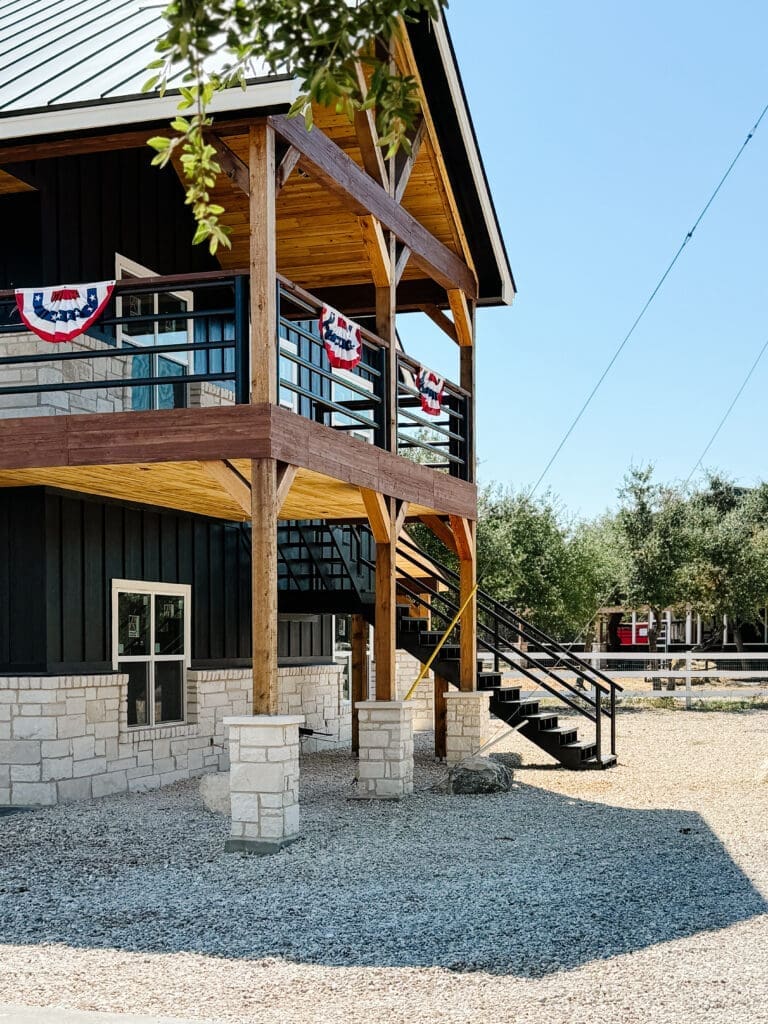
- Walk-out basement or lower level: A slope lets you build a daylight basement that feels nothing like a traditional basement — you can have full-height windows and direct outdoor access on the downhill side
- Split-level design: Staggered floor levels follow the natural grade and can feel more organically connected to the landscape
- Under-house garage or shop: On a downhill-facing slope, a garage tucked under the home is both aesthetically clean and practical
What sloped lots require is an experienced builder who understands how to engineer a foundation and drainage system that works with the terrain rather than fighting it. Read about what to expect when you’ve decided to build — we cover how site conditions affect design decisions early in the process.
Tree Preservation
One of the great assets of a Hill Country lot is the native oak and cedar. A well-designed floor plan and site plan will work around significant trees rather than bulldozing them — both for aesthetic reasons and because mature trees are genuinely valuable. Build-to-suit design, where the architect walks your lot and positions the home around existing tree canopy, is worth the extra effort.
Lot Orientation and Passive Solar Design
Where your home faces matters more in Central Texas than almost anywhere else in the country. Hill Country summers are intense, and a home oriented without regard to sun exposure will cost more to cool and be less comfortable to live in.
- South and southeast-facing glazing: Captures warming winter sun while staying shaded under roof overhangs in summer when the sun is high
- West-facing windows: Minimize these — west-facing glass in a Texas summer is brutal. If you have views to the west, manage them with deep overhangs, covered porches, or strategic landscaping
- North-facing windows: Cool, diffuse natural light all year — great for bedrooms, home offices, and art spaces
- Prevailing breeze: Cross-ventilation is free air conditioning when you design for it. Orient operable windows and doors to capture the prevailing southeast breeze
A designer who understands Hill Country climate will work these principles into your plan by default. If yours doesn’t bring it up, you should.
Open vs. Traditional Floor Plans in the Hill Country Context
The open floor plan has dominated new home design for two decades, and there are good reasons for that — but it’s not the right choice for every family or every site.
Why Open Plans Work Well Here
- Great for indoor-outdoor flow — a hallmark of Hill Country living
- Lets views from the back of the home reach through to the front entry
- Well-suited to entertaining and family living where kitchen, dining, and living are frequently used together
- Feels larger at a given square footage
Where Open Plans Have Trade-Offs
- Noise travels freely — harder for families where children sleep on different schedules than parents
- Harder to define distinct spaces for work-from-home scenarios
- Kitchen mess is always visible to the living and dining area
- Acoustically challenging without intentional sound design
The Case for Semi-Open Plans
A growing number of buyers are pulling back from fully open plans and embracing designs that maintain visual connection while providing acoustic separation — a dedicated study, a kitchen with a prep kitchen tucked behind it, or a sitting room off the main living space. For Hill Country homes where families are spending significant time at home, these plans often function better over the long term.
Single-Story vs. Two-Story on Hill Country Lots
The terrain affects this decision more than most people realize.
Single-Story Advantages
- Works naturally with the landscape — a long, low profile fits the Hill Country aesthetic
- No stairs — better for aging in place, young children, and dogs
- All living on one level simplifies daily life
- Typically easier to build on rocky terrain (less structural complexity)
When Two-Story Makes Sense
- Smaller footprint on the land — preserves more yard and tree coverage
- Upper level can capture views over tree canopy that a single-story can’t reach
- More efficient cost per square foot once the foundation is established
- Natural separation between adult and children’s bedroom zones
On steep Hill Country lots, a two-story design is often the most elegant solution — particularly if the upper level opens to views that justify the design cost. On large, flat acreage, a single-story ranch plan with generous covered porches is often the right choice aesthetically and practically.
Outdoor Living Integration: Design It In, Don’t Add It On
Covered outdoor living is not an amenity in the Hill Country — it’s a core part of how people use their homes. A floor plan that treats outdoor living as an afterthought produces a home that never quite feels right.
- Covered rear porch: Size for real use — at least 12 feet deep, preferably 16+ feet for furniture and an outdoor kitchen. Don’t undersize this space.
- Indoor-outdoor connection: Sliding or folding glass doors from the main living space that open fully to the porch — not a standard door that limits the connection
- Outdoor kitchen placement: Proximity to the indoor kitchen for service, wind direction for smoke, and good lighting for evening use
- Pool and spa placement: Orient for views and sun exposure; south or west-facing pools warm faster and stay warmer longer
- Fire pit area: Separate from the main porch — a gravel or flagstone pad with a fire feature and seating is a Hill Country staple
Our post on creating the ultimate Texas outdoor kitchen goes deep on the design and feature decisions worth making. Build those ideas into your plan from the beginning.
Garage and Shop Placement on Acreage
On an acreage Hill Country property, the garage isn’t just a garage — it’s often a workshop, storage facility, and hub for outdoor equipment. A few things worth thinking through:
- Attached vs. detached: An attached garage is convenient; a detached shop gives you flexibility in size, use, and placement without affecting the home’s design
- Orientation: Don’t let a front-facing garage dominate your home’s street presence. Side-entry or recessed garages preserve the front elevation’s character
- Shop vs. garage: If you have equipment, livestock, or a serious hobby space, a dedicated shop separate from vehicle storage is almost always worth it
- Casita proximity: If a guest house is part of your plan, its placement relative to the main home matters for privacy, access, and visual harmony
Check out our guide on choosing the right home builder — a builder with Hill Country acreage experience will have strong opinions on shop and outbuilding placement that a production builder simply won’t.
Frequently Asked Questions
What floor plan style works best for Hill Country properties?
Ranch-style single-story plans and L-shaped or U-shaped designs that wrap around outdoor living spaces tend to work exceptionally well in the Hill Country. They sit low in the landscape, maximize indoor-outdoor connection, and follow the terrain naturally. That said, every lot is different — a walk-out two-story on a ridgeline can be just as successful.
How do I choose a floor plan that works with a sloped lot?
Work with a designer who will walk your property before drafting anything. Slopes open options — walk-out lower levels, split entries, under-home garages — that flat lots don’t offer. Forcing a flat-lot plan onto a sloped site creates expensive engineering problems and misses real design opportunities.
How large should a covered porch be for a Hill Country home?
Minimum 12 feet deep for real usability; 14–16 feet is much better. Budget for ceiling fans, adequate lighting, and an outdoor kitchen rough-in even if you don’t build the kitchen at first. Covered porch square footage is some of the best-value space in a Hill Country home — don’t undersize it.
Should I buy a pre-designed plan or have a custom plan drawn?
Pre-designed plans are a great starting point and can save design fees. But most need modification for your specific lot and lifestyle. At minimum, have a local designer modify a stock plan for site orientation and local code compliance — never build a stock plan unmodified on a Hill Country lot.
How does single-story vs. two-story affect cost in the Hill Country?
Single-story homes cost more per square foot to build than two-story (more foundation and roof per living square foot), but they’re often simpler to engineer on complex terrain. Two-story homes are more structurally complex but require less footprint. On most Hill Country sites, a well-designed single-story is not significantly more expensive once terrain complexity is factored in.
How early in the process should I be thinking about floor plan?
From day one. Floor plan decisions affect lot selection, budget, timeline, and everything downstream. Don’t select a lot or finalize a budget without at least a rough sense of what you want to build. Good builders will help you think through plan concepts well before the formal design phase begins.
Ready to Start Your Project?
At Ridge Rock Builders, we specialize in custom homes, remodels, barns, shops, and casitas throughout the Texas Hill Country. Whether you’re still exploring your options or ready to break ground, we’d love to talk.
Get a free build estimate or call us at (512) 294-9579 to start the conversation.