Spend ten minutes on any home design website and you’ll find a thousand open-concept floor plans. They’re everywhere — and for good reason. But spend time in a Hill Country home on a 100-degree August afternoon with a full house of people and you may start to wonder whether one giant room was really the right call. The debate between open concept floor plans and defined spaces isn’t just a style preference — it’s a functional decision that affects how you live, how your home handles Texas heat and noise, and how your indoor and outdoor spaces connect. Here’s how we think through it with our clients.
The Case for Open Concept in Texas
Open-concept layouts — where kitchen, dining, and living areas share one continuous space — became dominant in new construction for good reasons. In Texas, many of those reasons are practical, not just aesthetic.
Indoor-Outdoor Flow
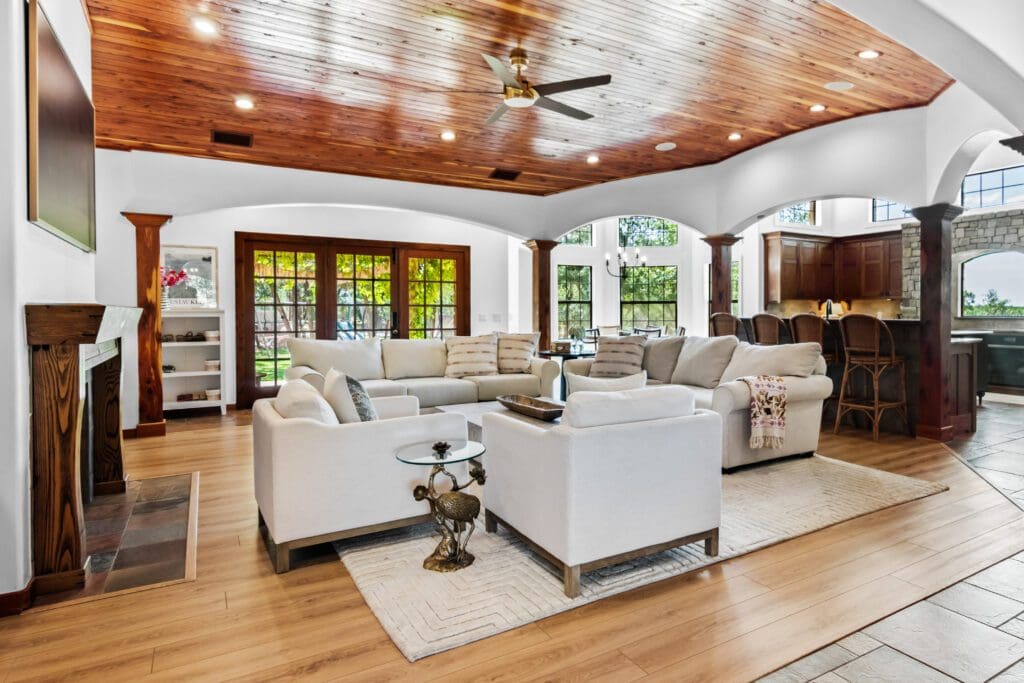
One of the biggest advantages of open concept in Hill Country homes is how naturally it connects to outdoor living. When your kitchen, dining, and living area are one continuous space, a wall of sliding glass or folding doors can extend the entire living area onto a covered porch or patio. During the 8–9 months a year when the weather cooperates, indoor and outdoor spaces feel like one room. It’s one of the defining features of Hill Country living, and open concept is the floor plan that enables it best.
Natural Light and Views
Hill Country lots often have remarkable views — to the south and west especially, where the terrain opens up. An open-concept layout allows you to position large windows and doors to capture those views from across the entire living space, not just from one room. When you’re standing at the kitchen island, you can see the sunset on the ridge. In a more compartmentalized layout, that view is locked behind a wall.
Supervision and Family Life
For families with young children, open concept makes supervision easy. The parent cooking dinner has eyes on kids in the living area. Homework happens at the island while dinner is made. These are real, daily-life advantages that a lot of families value.
The Case for Defined Spaces
Open concept has dominated so thoroughly that some of its real disadvantages get glossed over. Defined spaces — rooms with walls and doors — solve problems that open floor plans create.
Noise and Privacy
In an open-concept home, sound travels everywhere. The TV in the living room competes with the conversation at the dining table. When teenagers are gaming, parents working from home feel it. This is less of an issue in smaller households, but in a busy family home it matters. Defined spaces let you close a door and actually separate sound zones.
Cooking Smells and Mess
An open kitchen is a beautiful thing — until you’re frying fish for dinner and the smell has nowhere to go but the living room. A kitchen visible from the front entry has to be kept clean constantly. Some clients love the accountability; others find it exhausting.
Climate Efficiency
In a Texas summer, a large open space requires moving more conditioned air to maintain comfort. Defined spaces allow for zone-based HVAC — you can cool the rooms that are in use and let the others drift. This isn’t a dealbreaker for modern HVAC systems, but it’s a real consideration in a climate where cooling costs can be significant. Spray foam insulation and good mechanical design help mitigate this in open-concept homes, but it’s a factor.
Acoustic Separation for Work and Rest
With remote work now a permanent part of many households, having a study or home office that’s genuinely separated from the main living area has gone from a nice-to-have to a necessity. You can’t take a client call from a home office that opens directly into the kitchen. Some degree of separation matters.
How Hill Country Living Shapes the Decision
In our experience building throughout Dripping Springs and the surrounding area, the best Hill Country homes usually aren’t fully open or fully defined — they’re a thoughtful combination. Here’s what that typically looks like:
- Kitchen, dining, and living area share a connected, open zone — maximizing that indoor-outdoor connection to the covered porch or patio
- A home office or study is fully enclosed with proper acoustics for focus and calls
- A bonus room, media room, or game room is defined — ideally with a door, so noise can be contained when needed
- The primary suite is separated from the main living area — acoustically and spatially — so it functions as a true retreat
- Guest bedrooms or secondary bedrooms have separation from high-traffic areas
This hybrid approach gives you the entertaining benefits and visual openness of an open-concept main living area while preserving the functional separation that makes a home livable for all the other hours of the day.
Design Details That Make the Difference
Even within an open-concept main living area, there are design tools that create implied separation without walls — which helps the space feel purposeful and organized rather than just one giant room.
Ceiling Height Changes
Dropping the ceiling over the dining area from a vaulted 14 feet to a flat 10 feet creates a sense of enclosure without a wall. A coffered or beamed ceiling treatment over the kitchen island distinguishes it from the living area.
Flooring Changes
Transitioning from hardwood to tile in the kitchen zone — or using area rugs to anchor the living area — creates visual boundaries within an open space. Simple and inexpensive compared to adding walls.
Furniture Layout
In open-concept rooms, the furniture is the architecture. A sofa with its back to the kitchen creates a back wall for the living area. A large island divides cooking and social spaces. Plan your furniture layout before you finalize the floor plan — not after.
What We Recommend During the Design Phase
When clients ask us open or defined, we ask them a few questions first:
- Do you entertain often, and if so, large groups or small?
- How many people live in the home, and what are their ages?
- Does anyone work from home regularly?
- How important is a specific view from the main living area?
- Is outdoor living a priority?
The answers almost always point to a hybrid solution. We’ve built stunning Hill Country homes that are very open — great room flowing directly onto a 1,000-square-foot covered porch, kitchen island facing the views. We’ve also built homes for clients who wanted a formal dining room, defined entry, and a kitchen that could be closed off. Both work. The key is designing to your actual lifestyle, not to what’s trending right now.
If you’re working through these decisions and want a builder’s perspective on how floor plans affect everyday living, we’d love to be part of that conversation. Browse other topics on our blog or reach out directly to talk through your project.
Frequently Asked Questions
Is open concept going out of style?
It’s not going away, but the pendulum has started to swing back toward more defined spaces. The shift toward remote work accelerated the demand for proper home offices and acoustic separation. That said, in Hill Country custom homes where indoor-outdoor flow is a priority, a connected kitchen-dining-living zone continues to be a design strength. The trend isn’t toward fully closed floor plans — it’s toward smarter hybrids that combine the best of both.
Does an open floor plan cost more to build than a traditional layout?
Not necessarily. Open-concept layouts often eliminate interior walls, which can reduce framing costs. But they typically require engineered beams or headers to carry loads that walls would otherwise support — and those beams can be expensive. Large structural openings, vaulted ceilings, and the long spans common in open-concept great rooms often require more complex structural engineering. On balance, the framing cost difference is usually modest either way. The bigger cost driver is ceiling height, not openness.
How do I handle HVAC in an open-concept home?
Proper HVAC design is more important in an open-concept home than in a traditional layout because there are fewer natural barriers to control airflow. A good mechanical engineer will design a system that delivers conditioned air efficiently across the space. In Hill Country custom homes, we often recommend spray foam insulation and zoned HVAC systems — the combination handles Texas heat extremes better than older approaches. Work with a builder who coordinates closely with the mechanical engineer during design, not one who leaves HVAC as an afterthought.
What’s the ideal size for an open-concept great room in a Hill Country home?
There’s no single right answer, but in our experience, a kitchen-dining-living great room in the 600–900 square foot range feels generous without becoming overwhelming. Beyond 1,000 square feet of continuous open space, rooms can start to feel cavernous and hard to furnish. Design the space to fit how you actually use it — if you entertain large groups frequently, err bigger. If your daily household is two people, a more intimate scale will feel better on an ordinary Tuesday.
Can I add walls or create more defined spaces after the home is built?
Sometimes, but not always easily. Adding a partition wall in an open space is possible, but it may conflict with HVAC distribution, lighting placement, and structural elements designed around the open layout. It’s almost always cheaper to make these decisions during design than to retrofit them later. If you’re on the fence, talk it through before the plans are finalized — not after you’ve moved in.
How does a covered porch or outdoor living area change the open-concept equation?
Dramatically. When you have a well-designed covered porch or outdoor living space that connects directly to the main living area, you effectively add another “room” that exists outside. This means the indoor open space doesn’t have to do as much heavy lifting for entertaining — the outdoors absorbs the overflow. In our Hill Country builds, we often design the indoor open space to be slightly more intimate, knowing that the covered porch will handle large gatherings. This creates a better indoor scale without sacrificing outdoor entertaining capacity.
Ready to Start Your Project?
If you’re ready to work through floor plan options with a builder who’s done this a lot in Hill Country terrain, we’d love to talk. From Dripping Springs to Wimberley to Bee Cave, we’ve designed homes that work for how people actually live in this part of Texas.
Get a free build estimate or call us at (512) 294-9579. Let’s design something that fits your life, not just looks good on paper.